
Keywords: One-Person Company, Solopreneur, Entrepreneurship, Digital Economy, NACENTECH
(Abstract): In the digital era, entrepreneurship is no longer limited to companies with multiple founders, large teams, or significant capital. Thanks to digital technologies and artificial intelligence (AI), a single individual can now build and operate a professional business with little more than a computer and an internet connection.
This model, known as a One-Person Company (OPC) or Solopreneurship, was officially recognized in Vietnam’s policy agenda through the National Innovation and Entrepreneurship Strategy under Resolution No. 86/NQ-CP dated April 5, 2026. The Government has proposed applying and piloting this model to make entrepreneurship accessible to all citizens.
What Is a One-Person Company?
A One-Person Company is a business owned and operated by a single individual, leveraging technology, digital platforms, and intellectual property to create economic value.
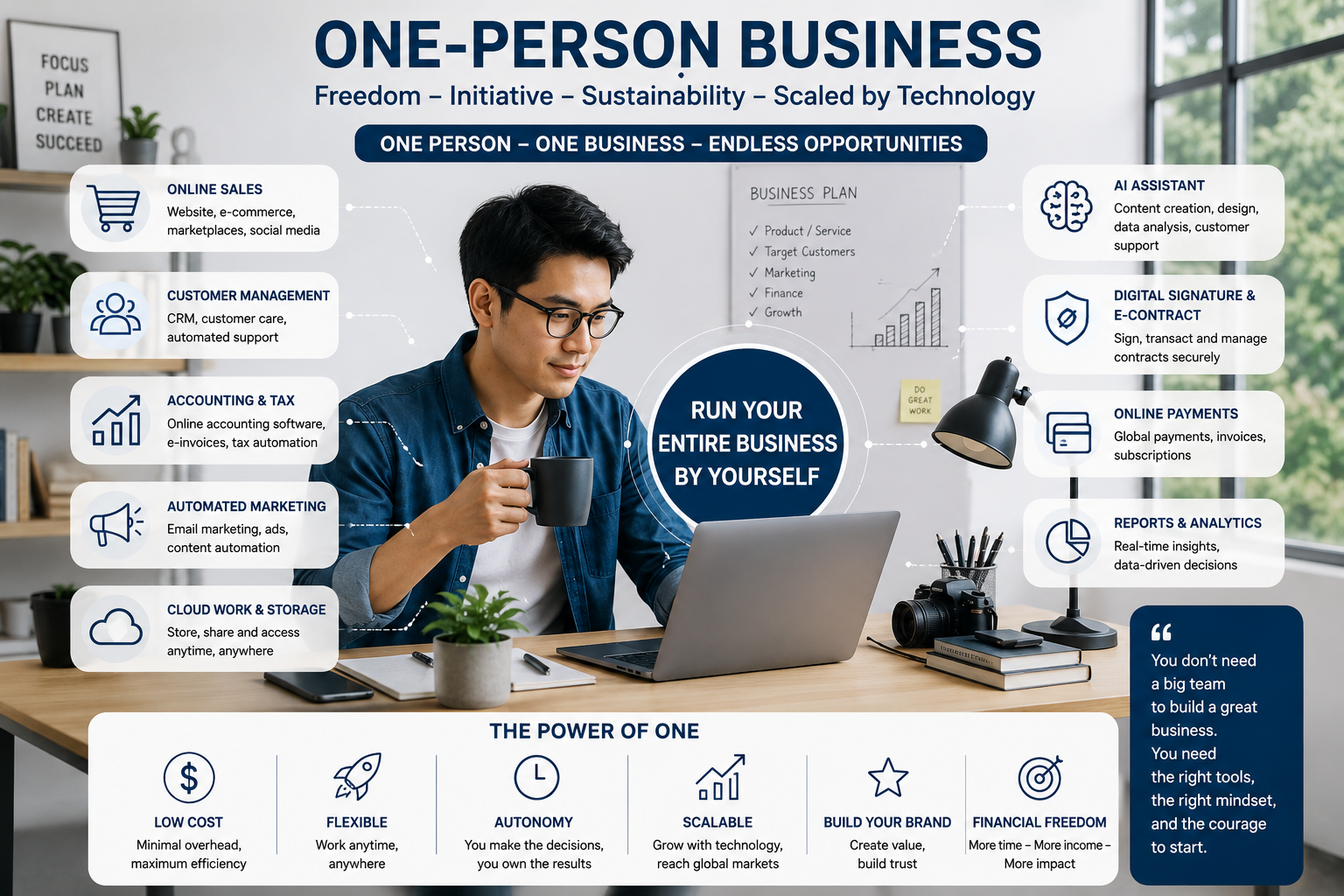
Unlike traditional businesses that require large teams and complex organizational structures, OPCs can operate efficiently through:
– Artificial Intelligence (AI)
– E-commerce platforms
– Digital management tools
– Online payment systems
– Cloud computing services
– Remote working platforms
One-Person Company vs. Freelancer
While both may be run by a single individual, a freelancer and a One-Person Company differ significantly.
| Criteria | Freelancer | One-Person Company (Solopreneur / OPC) |
| Business Nature | Delivers services directly to clients as an individual | Establishes and operates an independent business venture |
| Legal Form | Operates without a separate legal entity | Operates as a legally registered business entity |
| Revenue Model | Income is primarily linked to personal working hours and projects | Revenue can be generated from products, software, digital content, platforms, subscriptions, or e-commerce activities |
| Long-Term Goal | Generate income through professional skills | Build scalable business value and sustainable growth |
Source: NACENTECH, 2026
Consider a freelance graphic designer who obtains projects through freelance platforms or personal networks. The designer typically quotes a fee, completes the work, and delivers the final product on a project-by-project basis. Income is largely tied to the individual’s direct involvement and working time.
As the business grows, the same individual may choose to establish a One-Person Company. Instead of operating solely as a freelancer, they can register a business, develop their own brand, launch a professional website, use customer relationship management (CRM) software, digital accounting and e-invoicing systems, and conduct marketing through digital platforms. This enables them to serve multiple clients in a more professional and scalable manner.
Although the founder may still personally perform much of the work, they are no longer operating simply as an independent service provider. Rather, they are managing and growing a business with its own brand, systems, and long-term development strategy.
Is It Really Possible for One Person to Run a Business?
Increasingly, yes.
AI and digital tools are enabling individuals to handle tasks that once required entire teams, including marketing, customer service, accounting, sales management, and business operations.
Today, a One-Person Company can use AI for content creation and customer support, automated accounting software, online sales systems, digital advertising tools, and electronic payment platforms. As a result, startup costs are lower than ever, while access to customers has expanded dramatically.
Government Policy Direction: Removing Regulatory Barriers for One-Person Companies
 Source: Ministry of Science and Technology
Resolution No. 86/NQ-CP on the National Innovation and Entrepreneurship Strategy identifies innovation-driven entrepreneurship as a “mission for all citizens.” Within this vision, the One-Person Company model is considered a key solution for expanding entrepreneurial participation across society. Vietnam has therefore set a target of establishing approximately one million One-Person Companies by 2030.
Key policy directions include:
1. Simplifying Business Formation
– Enabling fully digital business registration;
– Streamlining administrative procedures and reducing barriers to entry.
2. Reducing Compliance Costs
– Developing simplified tax and accounting systems;
– Facilitating the transition of household businesses and independent workers into formally registered enterprises.
3. Piloting Regulatory Sandbox Mechanisms
– Developing an appropriate legal framework for One-Person Companies;
– Creating innovation-friendly environments with lower regulatory risks for new business models.
4. Providing Shared Digital Infrastructure
– Offering shared digital platforms and tools for accounting, taxation, financial management, human resource administration, and other essential business functions.
In addition to these broad policy measures, Vietnam is implementing a range of entrepreneurship support programs targeted at specific groups, including women, youth, students, and older adults.
Notable initiatives include:
– Women’s Entrepreneurship Support Program (2026–2035) (Project 2415);
– Youth Entrepreneurship Support Program (2022–2030);
– Student Entrepreneurship Support Program (2026–2035) (Project 336);
– Program for Older Adults to Promote Digital Transformation, Green Transformation, Entrepreneurship, and Job Creation.
Together, these initiatives reflect a consistent policy direction: making innovation-driven entrepreneurship accessible to all citizens, regardless of age, gender, background, or occupation.
From Informal Workers to Digital Entrepreneurs
The goal of creating one million One-Person Companies is not simply about increasing the number of businesses. It represents a broader strategy to help millions of individuals transition from the informal economy into the digital economy as entrepreneurs.
In the future, every citizen may have the opportunity to become a business owner, every innovative idea may become a viable business model, and entrepreneurship may become a pathway open to all.
That is the vision behind Vietnam’s goal of building an innovation-driven entrepreneurial society.
On this journey, the National Academy for Advanced Technology and Innovation (NACENTECH) stands ready to support individuals, startups, and SMEs through incubation and acceleration programs, as well as by connecting them with partners, investors, and experts. Through these efforts, NACENTECH aims to help transform innovative ideas into sustainable businesses that contribute to the growth of the digital economy.
Source: National Academy for Advanced Technology and Innovation (NACENTECH)